
Longevity care at Helix Advanced Medicine is not a promise of extra decades and it is not a supplement stack. It is a structured assessment of health span—the years you remain capable, metabolically stable, and free of preventable disease—followed by a written plan.
We combine unique laboratory testing, selected genetic markers, biological-clock estimates, VO2 max testing, evidence-based cancer screening, and inflammation reduction. Results are interpreted by a clinician in the context of your history, not printed as a “biological age” marketing score.
Unique laboratory testing
A standard annual panel is not a longevity workup. Depending on your age, history, and prior data, a Helix assessment may include an expanded metabolic profile, advanced lipids when indicated (apoB, lipoprotein(a), remnants—not LDL-C alone), hormone context relevant to energy, bone, muscle, and sleep, micronutrient testing when it would change a recommendation, and organ and muscle-health markers that relate to frailty risk. “Unique” here means decision-grade labs chosen for your risk, not the longest possible menu. We do not order a test that cannot change the plan.
Genetic markers
Genetics do not determine your outcome, but they can change how hard we look and how early we act. When appropriate, we discuss selected cardiovascular and lipid-related variants, pharmacogenetic information when it would affect a drug you may need, inherited cancer-predisposition testing only with counseling when personal or family history supports it, and ApoE and other neurologic-risk markers only after you understand what the result can and cannot tell you. A risk allele is not a diagnosis. Findings are used to refine screening intervals, lipid targets, or family counseling—not to claim we can edit your lifespan.
Biological clocks
Biological-age estimates (epigenetic or other aging clocks) can add a trend signal: whether your physiology looks older, similar, or younger than your calendar age, and whether that estimate moves after we treat blood pressure, glucose, sleep, weight, fitness, or inflammation. Clocks are estimates, not a medical age. Different clocks can disagree. A single number without a plan is entertainment. We use clocks as one input beside labs, VO2 max, body composition, and screening—not as the product.
VO2 max testing
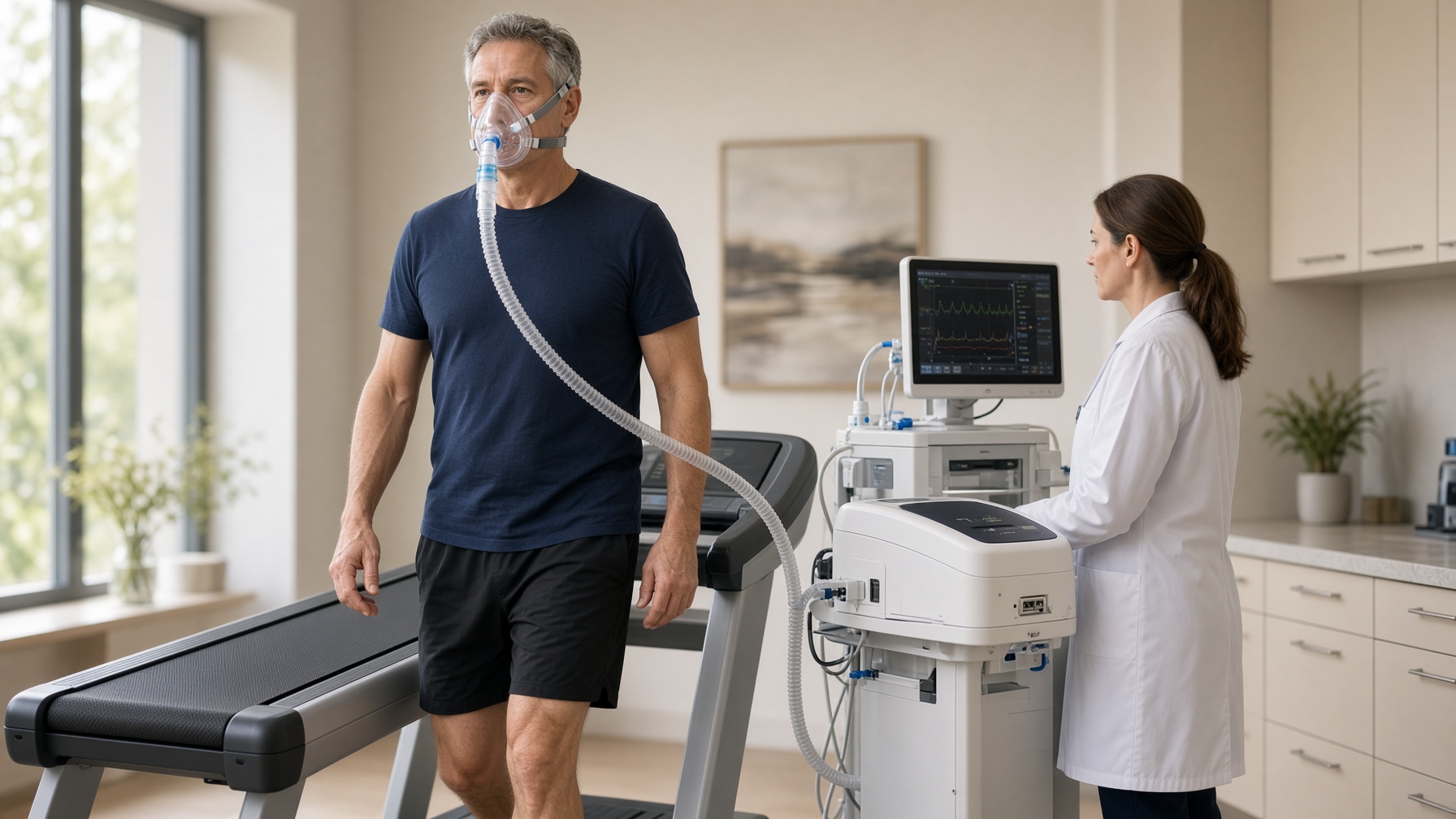
VO2 max is the best widely available measure of cardiorespiratory fitness. Large studies link higher VO2 max to lower all-cause and cardiovascular mortality. It is one of the few longevity metrics you can train. At Helix it is used to establish a fitness baseline independent of weight or resting heart rate, sort reserve for your age and sex, guide training zones, and track whether the plan is actually improving capacity. Testing is a supervised exercise assessment. A low score is not a verdict. It is a training target. A high score does not cancel the need for lipids, cancer screening, or blood-pressure control.
Cancer screening
Early detection is one of the few longevity tools with a clear job: find disease while it is still treatable. Your plan is built from age, sex, family history, genetic risk, and prior results, and typically includes guideline-based screening. When it would change care, we may discuss additional tools such as whole-body MRI or emerging multi-cancer blood tests (liquid biopsy). Those tests can miss cancers and can produce false positives. They do not replace colonoscopy, mammography, or other standard screening.
Inflammation reduction
Chronic, low-grade inflammation accelerates vascular disease, metabolic disease, and frailty. We treat causes, not a slogan: visceral fat, insulin resistance, and atherogenic lipids; sleep apnea; smoking and excess alcohol; periodontal and other chronic inflammatory sources; low fitness and low muscle mass; and a food pattern that supports vascular and metabolic health. We do not use chronic high-dose NSAIDs as an anti-aging drug. Unapproved “anti-inflammatory peptides” or IVs are not a substitute for the work above.
Who this program may be for
- Adults who want a baseline before midlife risk accumulates
- People with family histories of early heart disease, stroke, cancer, or dementia
- Patients who want a measured fitness number (VO2 max), not only a lab printout
- Patients already in the practice for lipids, hormones, or weight who want those programs tied to a longer-horizon plan
- Patients who want to predict what type of activities they can do at a certain age and what to do now if they want to be better fit at that age